


In short:
- EDT, EDP and extrait de parfum describe how much perfume oil is in the bottle: roughly 5 to 15, 15 to 20, and 20 percent or more.
- More concentration means a longer-lasting base, which matters most in Indian heat and humidity, where top notes burn off fast.
- Extrait sits closer to the skin than an EDT. It lasts longer without being louder.
- Two or three sprays of extrait are enough for most days; one or two in humid weather.
Every bottle carries a word under its name. Eau de toilette, eau de parfum, extrait de parfum. Most people read it as a quality grade or a marketing tier. It is neither.
The word tells you one thing: how much perfume is dissolved in the bottle. Everything else that people say about these labels, how long they last, how loud they are, why one costs more, follows from that single number.
In a mild climate the difference is a matter of taste. In Indian weather it decides whether a fragrance is still with you after lunch.
What the labels actually mean
A fragrance is aromatic material dissolved in alcohol, with a little water. The label describes the share of aromatic material, which perfumers call the concentration.
| Label | Also written as | Typical concentration |
|---|---|---|
| Eau de Cologne | EDC | 2 to 5 percent |
| Eau de Toilette | EDT | 5 to 15 percent |
| Eau de Parfum | EDP | 15 to 20 percent |
| Extrait de Parfum | Parfum, Pure Parfum, Extrait | 20 percent and above |
| Attar | Perfume oil | Oil based, no alcohol |
Two things about this table matter more than the numbers in it.
First, no law fixes these ranges. Each house decides what its own EDT or extrait contains, so the bands overlap from brand to brand. Treat them as conventions, not certificates.
Second, "Parfum", "Pure Parfum" and "Extrait de Parfum" all name the same top tier. When a label says only "Parfum", it means extrait.
Why more concentration means more wear
Every fragrance evaporates. The alcohol goes first, carrying the brightest notes with it, and the heavier materials leave last. That order is the pyramid you read on a product page: top notes, then heart, then base.
A higher concentration puts more aromatic material on your skin with every spray. There is more of each note to evaporate, so each stage of the pyramid lasts longer, and the base, which is the part that carries a fragrance through the day, has far more to give.
Same formula, three concentrations, three different days. The EDT gives you the opening and a short heart. The EDP holds the heart longer. The extrait reaches the base and stays there.
If you want the full picture of what extends wear beyond concentration, from skin preparation to where you spray, we covered it in how to make perfume last longer in Indian heat.
Why this matters more in Indian weather
Most fragrance advice is written for twenty degrees and dry air. Indian weather changes two things at once.
Heat speeds up evaporation. Warm skin burns through top notes in minutes rather than in the first hour. Citrus, mint and aldehydes are the first to go, which is why a bright EDT smells wonderful at the door and has gone by the time you reach work.
Humidity carries scent further but does not make it last. Moist air lifts a fragrance off the skin, so it projects strongly at first. Sweat then dilutes what is left. A light concentration gets used up fast on both counts.
An extrait answers both problems with quantity. There is more top note to burn through, and a deeper base waiting underneath when it does. That is the reason the strongest concentration is the sensible choice for a hot country, not the indulgent one.
Dry heat and humid heat need different handling
India has both, and they punish fragrance in different ways.
Dry heat, the north in May and June, strips moisture from the skin. Fragrance evaporates fast and has nothing to hold on to. Moisturise before you spray, and favour skin that your clothes cover.
Humid heat, the coast for most of the year and everywhere in the monsoon, keeps the air heavy. Scent hangs around you and feels stronger than it is. Spray less, and put one spray on fabric rather than on warm skin, where sweat will dilute it.
Air-conditioned offices are a third climate. Cool, dry, recycled air flattens fragrance and keeps it close. This is where an extrait's quiet, steady trail is most useful.
Projection is not longevity
One misunderstanding puts people off extrait: the belief that a stronger concentration is a louder fragrance. It works the other way.
Alcohol is what throws a scent into the room. An extrait carries proportionally less of it, so it sits closer to the skin and builds a quieter, denser trail. An EDT shouts for an hour. An extrait speaks at a normal volume all day.
This makes extrait the better choice for offices, meetings and long dinners, where the goal is to be noticed by the person next to you rather than the whole room.
So is extrait too strong for Indian heat? No. Too many sprays of it are. The concentration is not the problem. The dose is.
Is extrait de parfum worth the price?
An extrait costs more per bottle because it holds more of the expensive part. The alcohol is cheap. The aromatic material is not.
The fairer comparison is cost per wear. Two or three sprays of extrait do the work of a much heavier hand with an EDT, and they do it for longer. A smaller bottle of extrait lasts as many days as a larger bottle of something lighter, and you are not reapplying at four in the afternoon.
If you only own one fragrance for daily wear in India, the concentration matters more than the brand.
How much extrait to wear, by season and setting
Extrait needs fewer sprays than you are used to. Start here and adjust to the composition: a fresh one takes the upper end, a dense oud or amber the lower.
| Setting | Sprays | Where |
|---|---|---|
| Summer day, outdoors | 2 | Chest under the shirt, and the collar |
| Humid or monsoon day | 1 to 2 | Collar or shirt, not wrists |
| Air-conditioned office | 2 | Base of the neck, chest |
| Evening out or dinner | 3 | Neck, chest, collar |
| Winter day | 3 | Neck, chest, scarf or shawl |
| Wedding or a long function | 3, plus one on fabric | Neck, chest, inside the collar |
How to wear an extrait
- Two to three sprays is enough. One at the base of the neck, one on the chest, one on the shirt collar.
- Spray onto skin that is clean and moisturised. Fragrance holds on skin that has something to bind to.
- Do not rub your wrists together. It crushes the top notes and rushes the base forward.
- Let it settle for ten minutes before judging it. The opening of an extrait is its least representative moment.
- Keep the bottle in a dark cupboard. Heat and light degrade any concentration, and a bathroom shelf in summer degrades it fastest.
Extrait or attar?
India has its own answer to long-lasting fragrance, and it is older than any of these labels. Attar is perfume oil with no alcohol at all, dabbed straight onto the skin.
Without alcohol to lift it, an attar stays very close to the body. It is intimate, slow and personal, and it suits quiet days, close company and anyone who wants their fragrance to be discovered rather than announced.
An extrait carries a little alcohol, so it opens up and moves around you, while still holding far more aromatic material than an EDP. It suits days that move between places: the commute, the office, the evening.
Choose attar to keep a scent to yourself. Choose extrait to share it at arm's length.
Extrait does not have to be heavy
Many people associate extrait with oud, amber and evening wear. Concentration says nothing about character. A citrus or aquatic composition can be an extrait too, and in Indian weather that is exactly where the extra strength earns its place, because fresh notes are the ones heat takes first.
Scentedelic's Exceptional Extraits
Scentedelic's extrait line is the Exceptional Extrait series: ten fragrances made at extrait strength, each named for a form of Shiva. They lean warm and resinous, built on incense, oud, sandalwood and amber. Three to start with:
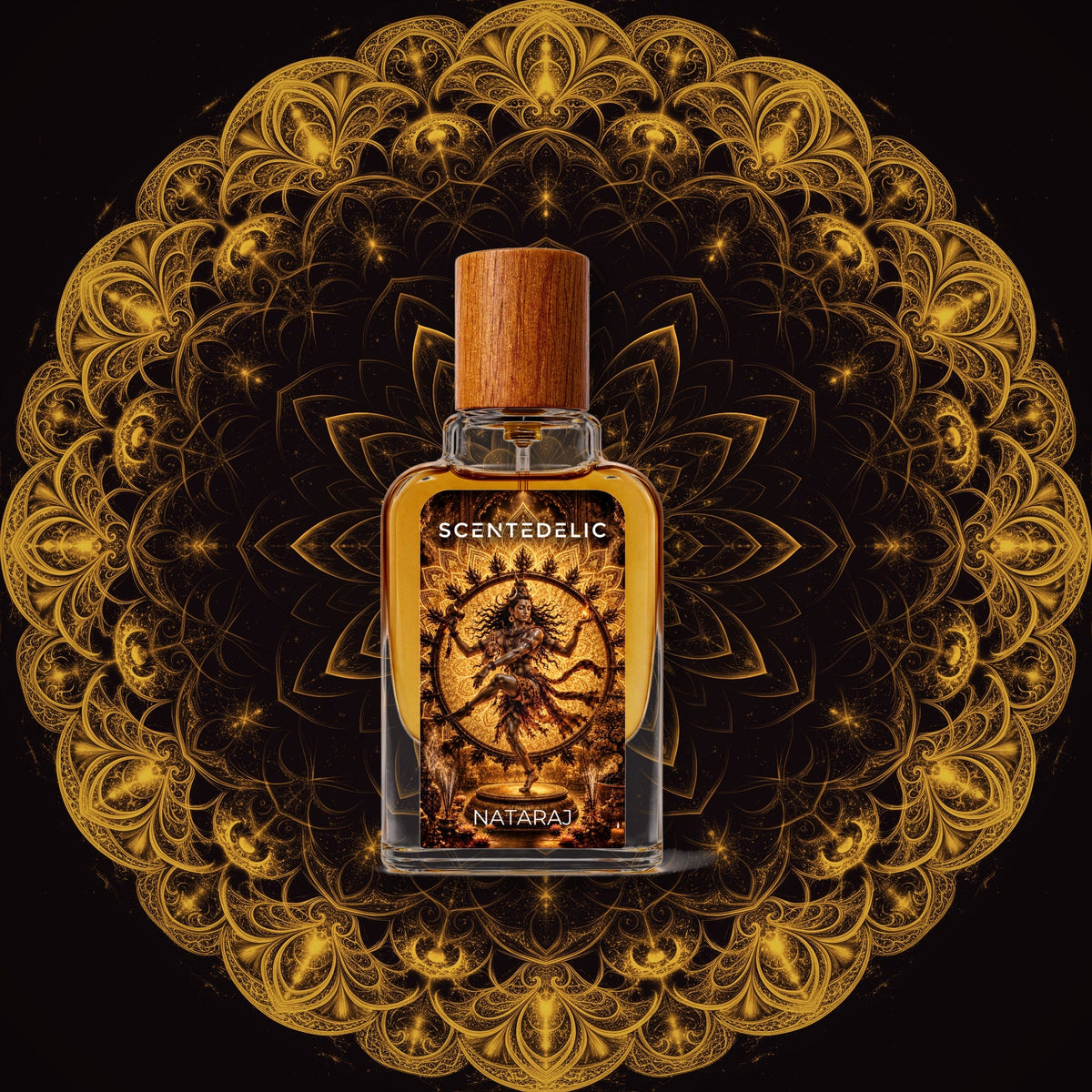
Nataraj, the dancer
Coffee at the top, over frankincense and vanilla absolute, settling into benzoin, amber and labdanum. Resinous and gently sweet, with the coffee keeping it lively.
Neelkanth, the blue throat
Oregano, pimento and bergamot open onto incense, amber, opoponax and labdanum, with smoke, oud, leather, patchouli and sandalwood beneath. The darkest of the three, and the one for cold evenings.
Ardhanareshwar, half Shiva, half Shakti
Aldehydes, lily of the valley and rose over frankincense and labdanum, settling into white musk, benzoin and ambergris. Bright at the top and resinous underneath.
To try before choosing a bottle, each scent in the Exceptional Extraits collection comes as a 3 ml sample.
How to choose your first extrait
Choose by the hours you need it for, not by the strongest name on the shelf.
- For daytime heat and the office, start with a fresh, aquatic or aromatic composition. The extrait concentration does the work that a heavy base would otherwise do.
- For evenings and cooler months, move to woods, ambers and gourmands, where the base is the point of the fragrance.
- If you are unsure, pick the one whose dry down you like. The opening lasts minutes. The base is what you will live with.
Frequently asked questions
What is extrait de parfum?
Extrait de parfum is the highest concentration of fragrance, usually 20 percent aromatic material or more, dissolved in alcohol. It is also sold as "Parfum" or "Pure Parfum".
Is extrait de parfum better than eau de parfum?
For longevity, yes. The same formula as an extrait outlasts its EDP and EDT versions because there is more of every note to evaporate. Better also depends on the composition itself, so a well-built EDP beats a poorly built extrait.
How long does extrait de parfum last?
Longer than the EDP or EDT of the same formula. The exact time depends on the composition's base notes, your skin and the weather. Woody, amber and resinous bases last longest, and fresh compositions benefit most from the higher concentration.
Is extrait de parfum oily?
No. An extrait is still an alcohol-based spray. It holds more aromatic material than an EDP, so it feels slightly richer, but it dries on the skin the same way.
Does extrait de parfum contain alcohol?
Yes, in most cases. It contains less alcohol than an EDT or EDP and more aromatic material. Attar is the alcohol-free tradition: perfume oils worn directly on the skin.
How many sprays of extrait de parfum should I use?
Two to three for most days, and one to two in humid weather. Past that point you add intensity for the people around you without adding much wear.
Is extrait de parfum too strong for Indian heat?
No. An extrait sits closer to the skin than an EDT, and heat uses up a fragrance faster, so the extra concentration is what keeps it going. Too many sprays is what makes any fragrance overpowering in the heat.
Is extrait de parfum better than attar?
Neither is better. Attar is oil with no alcohol and stays very close to the skin. Extrait is alcohol based, projects a little further and is easier to spray evenly. Choose by how far you want the scent to travel.
Is extrait de parfum good for Indian summers?
It is the best concentration for them. Heat burns through top notes quickly, and an extrait has more to burn through and a deeper base underneath. Choose a fresh or aquatic composition for the hottest months.
Scentedelic's Exceptional Extraits are hand-crafted for Indian weather, where anything built lightly does not last the day. Explore the series.


Leave a comment
This site is protected by hCaptcha and the hCaptcha Privacy Policy and Terms of Service apply.